Where the two decks differ
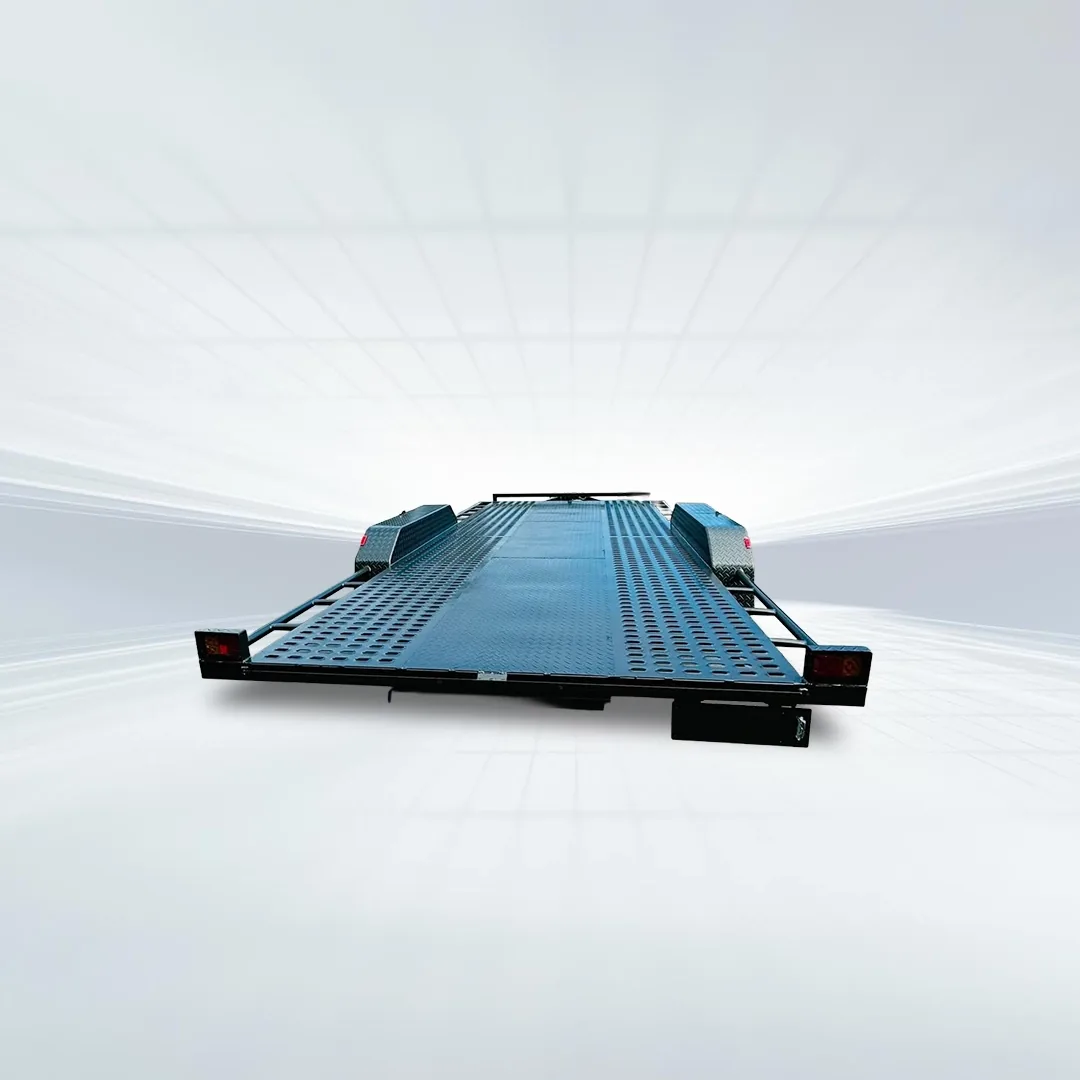
A semi-flat car trailer is one straight deck at a single height from the coupling through to the tail. A beavertail is the same trailer with the rear section — the part behind the rear axle — stepped down and sloped, so the back edge of the deck sits closer to the road.
Steel Box builds both. The beavertail car trailers are 14 ft and 16 ft decks; the semi-flat car trailers run 14 ft, 16 ft and 18 ft. All are 6 ft 6 in wide. A 14 ft deck is 4.27 m, a 16 ft is 4.88 m and an 18 ft is 5.49 m, so the length you pick is really a question of what has to sit on it.
That one difference in the deck decides the rest of it: the loading angle, how much ramp you have to carry and handle, where the car actually sits, and what else the trailer is good for once the car is off it.
Loading angle: what the tail buys you
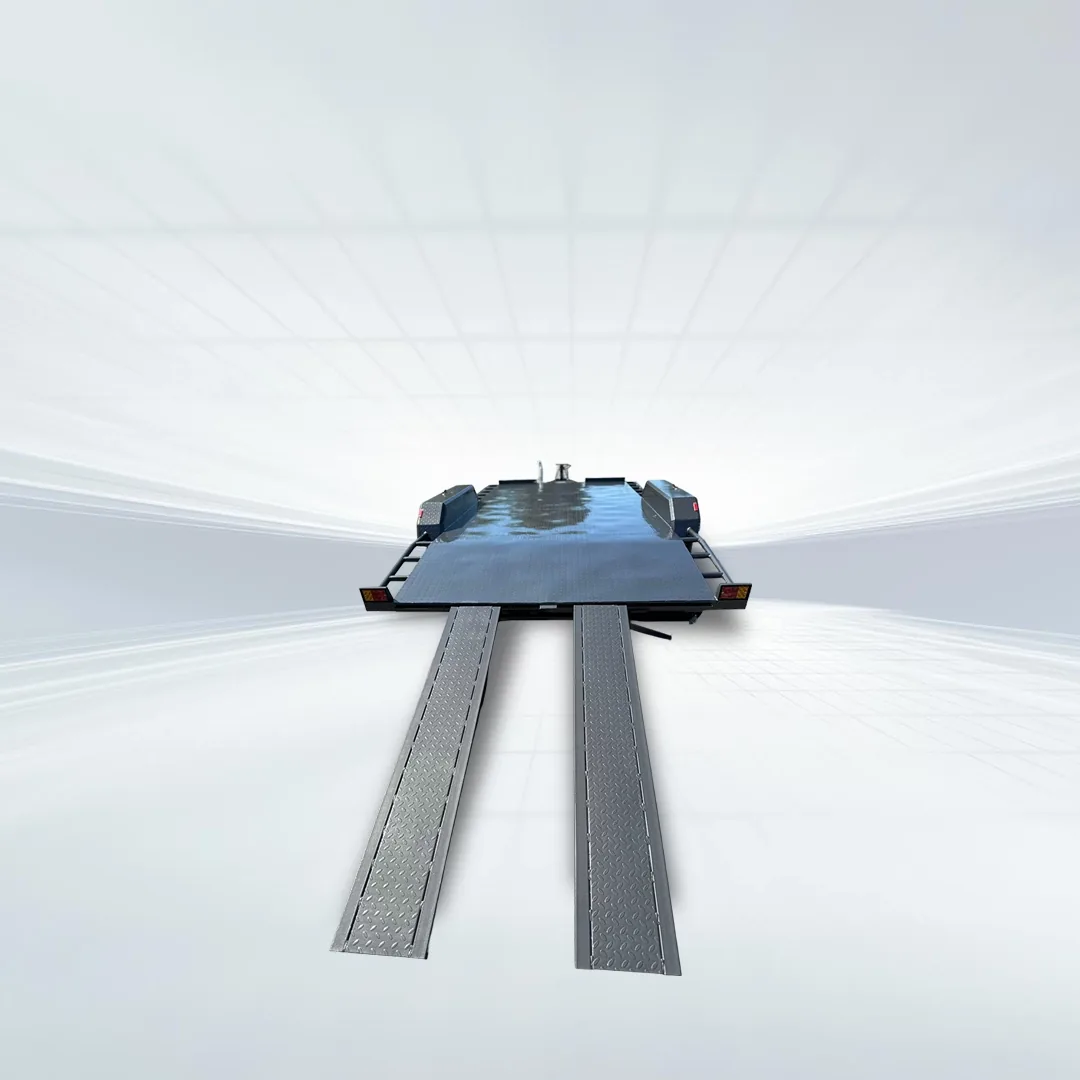
An angle is set by how far the ramp has to climb. On a semi-flat the ramp has to reach full deck height, so the ramp needs to be long to keep the climb reasonable. On a beavertail the ramp only reaches the tail, which sits lower, and the car then rides the long slope up to the main deck. The steepest part of the whole path is gentler than a semi-flat's ramp — and that is what stops a front lip, a splitter, a low sump, a side skirt or a long rear overhang catching on the way up.
If you are loading a lowered car, a club car, a car with a bodykit or anything with less than about a hand's width under the front bar, this is the whole argument for the beavertail. It is also the easier trailer to load on your own, because a gentler angle means less winching and less clutch work at the bottom of the ramp.
The tail is a trade, not a free win. Because the rear of the trailer sits lower, you have less clearance underneath when you reverse it over a spoon drain, a steep driveway lip, a kerb or a rutted paddock entrance. And because the tail is a slope rather than floor, it is not the right deck for a load that needs a flat surface the full length.
The numbers, side by side
| What you are comparing | Beavertail | Semi-flat |
|---|---|---|
| Deck shape | Level forward deck, stepped-down sloped tail behind the rear axle | Level deck the full length, one height |
| Loading angle | Gentler — ramps climb to the tail, then the slope does the rest | Steeper for the same ramp, because the ramp reaches full deck height |
| Ramps | Slide-in, and the lower start means you are working with a shorter climb | Slide-in, and the ramps do all the height so they want a longer clear run behind the trailer |
| Best load | Low cars, lowered cars, one-person loading, a car you tow occasionally | Cars plus gear, 4WD utes, pallets, mowers and plant that want a flat floor |
| Deck lengths in stock | 14 ft, 16 ft | 14 ft, 16 ft, 18 ft |
| GVM options in stock | 1990 kg, 2800 kg, 3200 kg | 1990 kg, 2800 kg, 3200 kg, and tri-axle 3500 kg and 4500 kg |
| Ground clearance at the tail | Lower — watch spoon drains, kerbs and steep driveways when reversing | Higher and flat — easier over rough ground and through gateways |
| Price | GST-inclusive AUD on every listing, with the GVM stated. Delivery is free anywhere in Australia. |
Deck layout and ramp use
Both trailers load from the rear over slide-in ramps, and both list their GVM on the product page, which is the number that decides whether your tow vehicle can legally pull it. What changes is the partnership between ramp and deck.
On the semi-flat, deck and ramp are separate jobs: the deck is flat, and the ramp is a long climb. You want a straight, clear run behind the trailer roughly as long as the ramps plus the car's approach, so put the trailer where you have that room before you unhitch. In return you get a deck you can walk around, set a pallet on, roll a mower up, or strap a car to at four square corners.
On the beavertail, the tail does part of the ramp's work. That means less ramp to handle at the back of the trailer and a shorter run behind it, but it also means the load transitions twice — ramps to tail, tail to deck — so the car's wheelbase and rear overhang need to clear that transition. A very long rear overhang on a very low car is the case to check before you buy, not after.
Which one for which job
- Lowered car, club car or a car with a bodykit: beavertail. The gentler effective angle is the point of the design.
- Everyday sedan or hatch, towed a few times a year: the 16 ft beavertail at the lower GVM rating, provided the payload covers the kerb weight of the car after the trailer's tare comes off.
- 4WD ute, long-wheelbase wagon or a big sedan: start looking at the 18 ft semi-flat. A 5 m-plus vehicle on a 4.88 m deck leaves nothing for positioning, and positioning matters for towball download.
- Car plus gear on the same trip: semi-flat. Bikes, a quad, spare wheels, a toolbox or a set of tyres all want flat floor rather than a slope.
- Pallets, a ride-on mower or small plant: semi-flat, and check the tri-axle ratings — 3500 kg and 4500 kg GVM — if the load is heavy as well as awkward.
- Loading on your own, in the dark, after a long day: beavertail. Less climb means fewer second attempts.
GVM, brakes and registration
Buy on GVM, not on looks. The trailer's GVM minus its tare is the payload, and the payload has to cover the kerb weight of the car plus fuel and whatever is left in it. Then the trailer has to sit inside your tow vehicle's braked towing capacity, its towball download limit and its gross combination mass — the lowest of those three is your real ceiling. GVM, tare and trailer brakes explained walks through it; the sizing question is covered in the trailer range alongside each listing's stated rating.
Registration rules differ between the states and territories, including when brakes are required, so the trailer has to be registered where it is used. Tell us the state and the tow vehicle when you enquire and we will talk you through the paperwork.
Price, delivery and collection
Every listing carries a GST-inclusive AUD price and the GVM, so the two trailers are easy to line up against each other without a phone call. Delivery is free to any address in Australia, metro or remote — the freight is already in the listed price and nothing is added to the invoice — and collection from the Melbourne yard is free if you would rather hook it up yourself.
Trailers are collected ready to tow or delivered by transport. Nothing is charged on the website: checkout or a quote request returns an emailed invoice, paid by bank transfer, PayID or an emailed card payment link, and dispatch is 2–5 business days after payment clears. If you are not sure which deck suits the car in your shed, send us the rego details or the measurements and we will tell you straight — get a quote or ask the question.