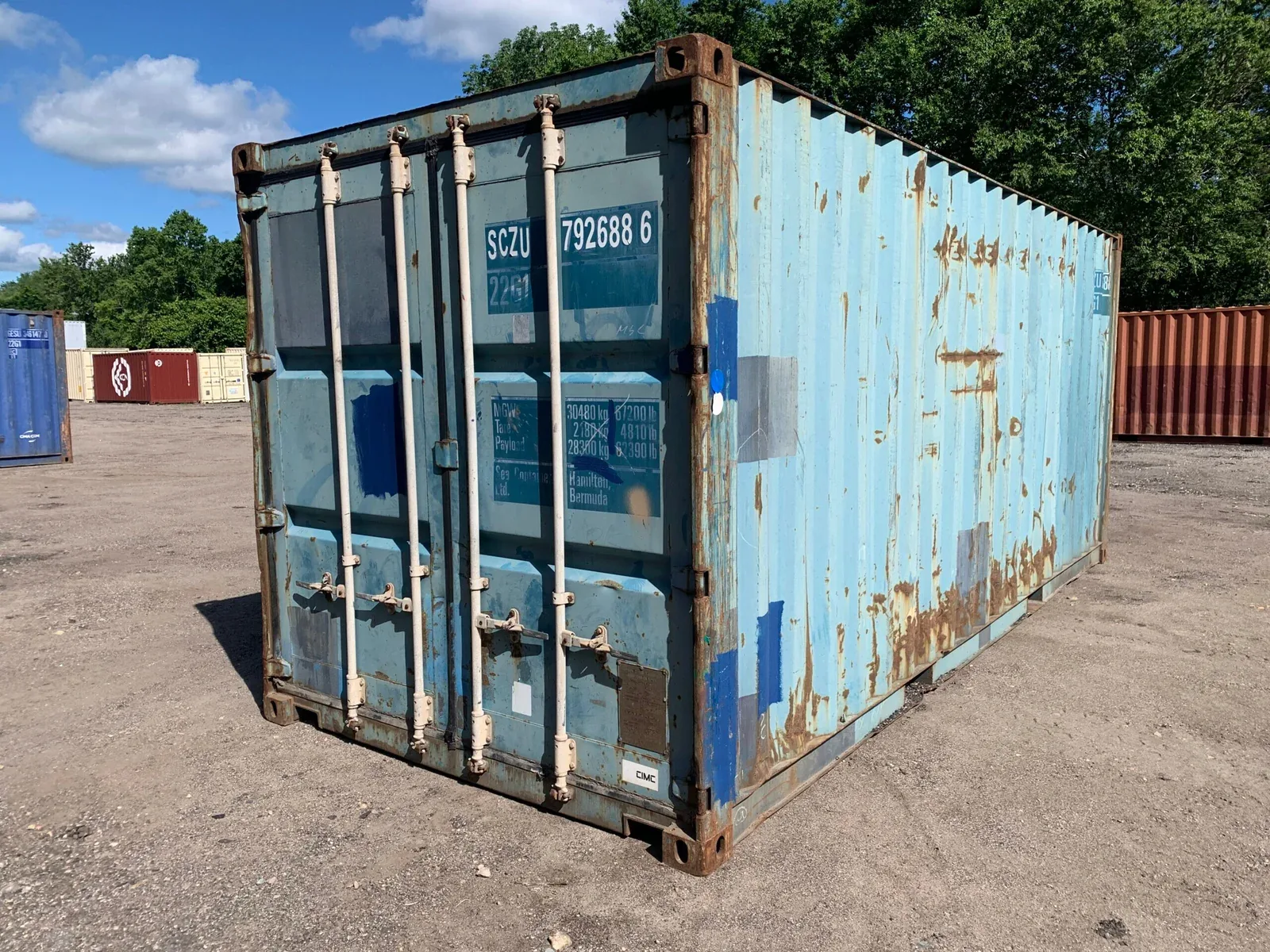
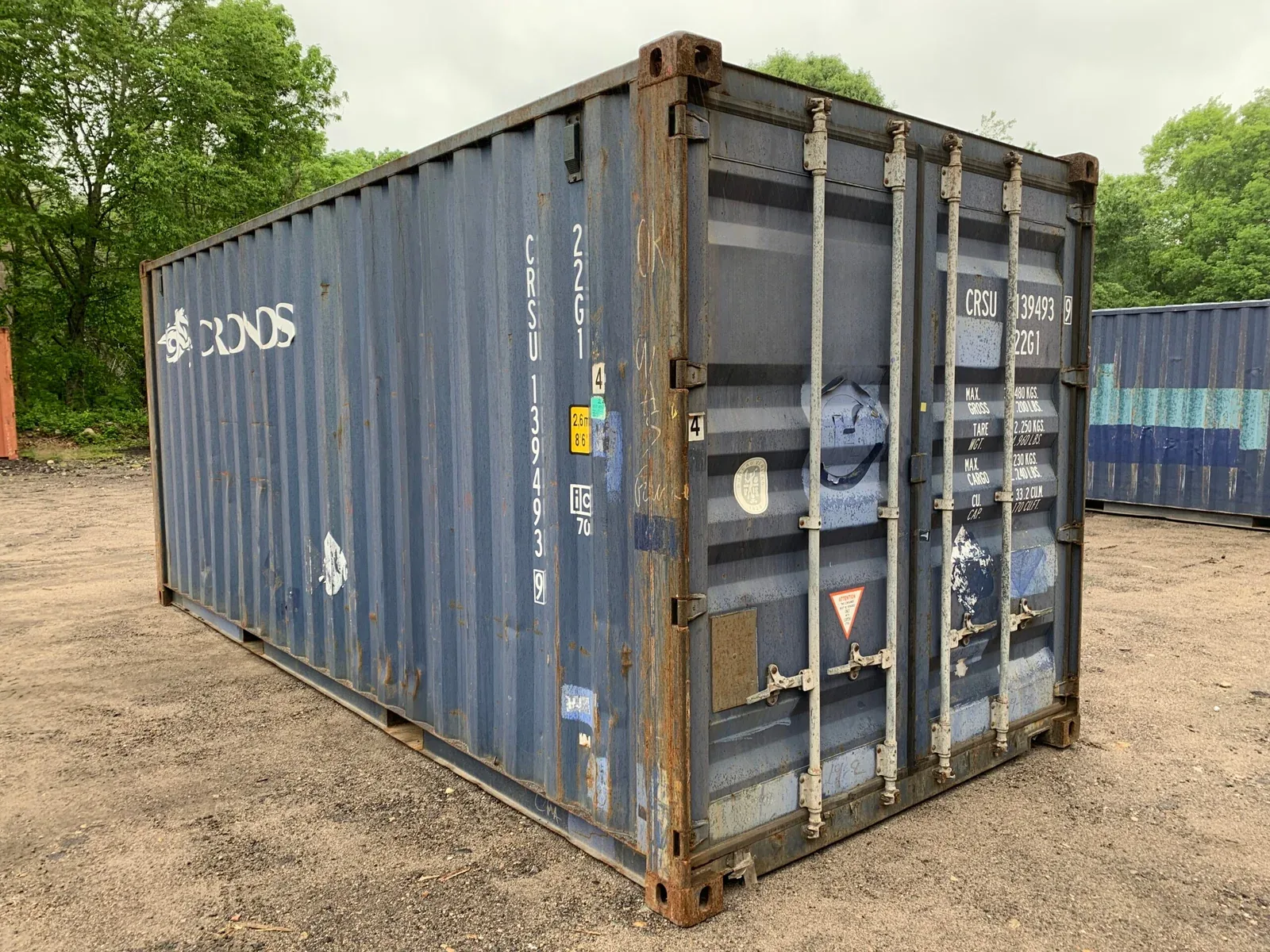
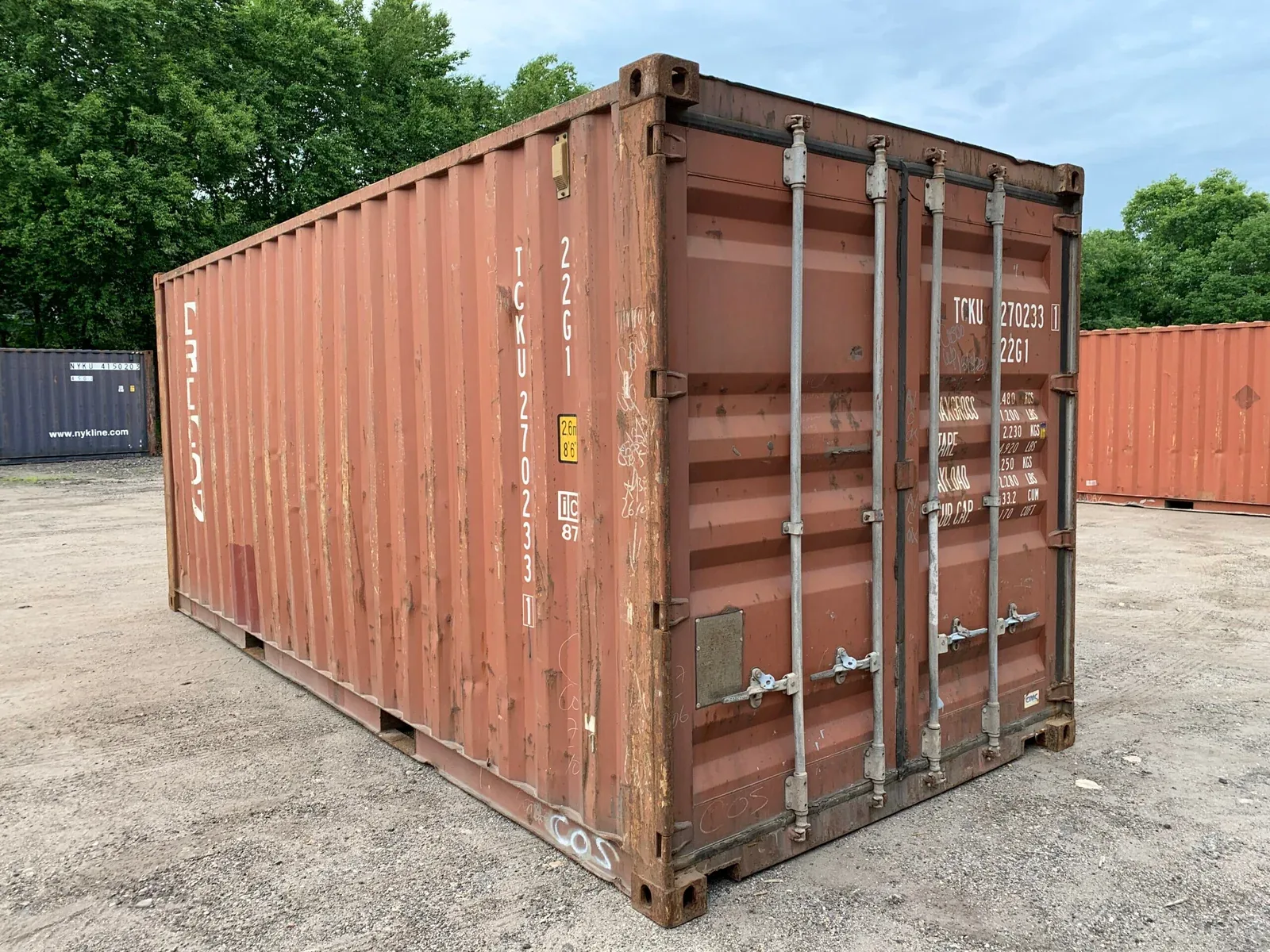
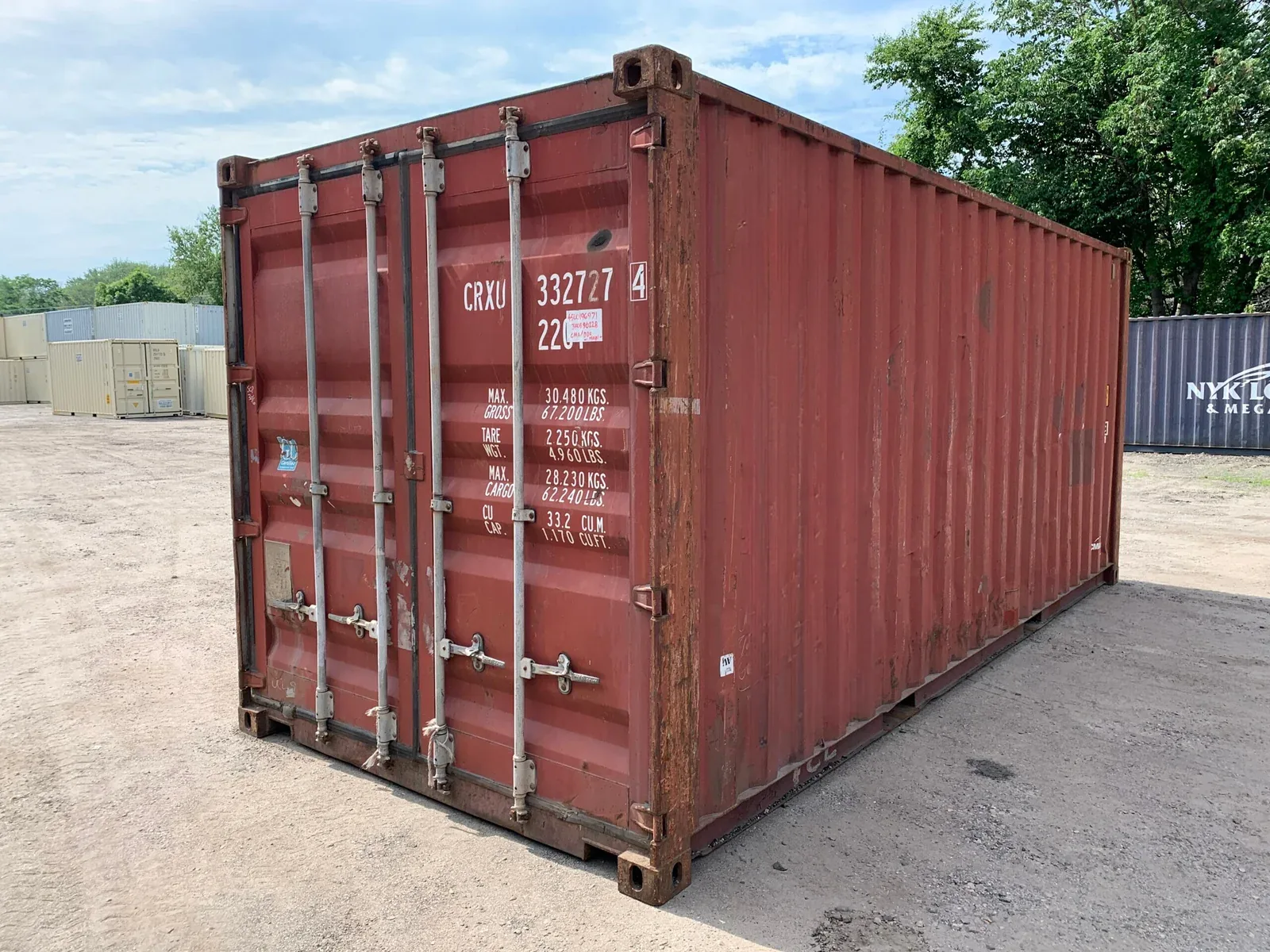
The inside, measured
These are the internal dimensions shown on the 20 ft listings, not the external ones on the spec plate. Work from the internal figure and leave yourself a hand's width to swing things around.
| Measurement | Standard 20 ft | High cube 20 ft |
|---|---|---|
| Internal length | 5,898 mm | 5,898 mm |
| Internal width | 2,352 mm | 2,352 mm |
| Internal height | 2,385 mm | 2,698 mm |
| Floor area | about 14 m² | about 14 m² |
| Internal volume | about 33 m³ | about 39 m³ |
| Door opening | 2,340 mm W × 2,280 mm H | 2,340 mm W × 2,585 mm H |
| Maximum payload | about 28,000 kg | about 28,000 kg |
| Maximum gross weight | 30,480 kg | 30,480 kg |
Two numbers on that table are the ones buyers come unstuck on: the door is lower than the ceiling, and the floor is 5.9 m long, not 6 m.
What fits, job by job
Moving out of a unit or a small house
A one-bedroom unit goes in with room to walk between the loads. A two-bedroom unit fills it to the walls — beds on their sides, sofa upright, cartons to the roof. Once you add a third bedroom and a garage, the box is full and overflowing, which is the point most people move up to a 40 ft rather than buy a second 20 ft.
Volume stops household loads long before weight does. You can put a whole unit's contents in a 20 ft and still be twenty tonnes under the payload limit.
A tradie's tools and materials
Rack both long walls at 400 mm deep and you still have a 1,550 mm aisle down the middle — wide enough for a wheelbarrow or a set of trestles. That is about 11.8 m of wall run to shelve, which is the reason a 20 ft beats a garage for a chippie or a sparkie: the gear is in one place, locked, and you can find it.
Lengths are what to count before anything else:
- anything under 5.9 m goes in straight and the doors still close — 2.4 m, 3 m and 4.8 m lengths are all easy
- a full 6 m length only fits on the diagonal, corner to corner, which measures 6,350 mm across the floor. It goes in, but you cannot then pack around it
- a 2,400 mm sheet of ply will not stand upright in a standard box, because the internal height is 2,385 mm — it lies flat, or goes on the diagonal, or you buy the high cube and stand it up
Pallets and stock
Ten standard 1,165 mm pallets fit in a single tier: five rows of two. Two side by side come to 2,330 mm in a 2,352 mm width, so they touch — load them straight and leave the forklift room at the door. Stack a second tier and that is twenty pallets, provided the load underneath can carry it.
Hand-loading is the other way to use the space, and it is far denser: a 20 ft swallows a small retail fit-out, a season of packaging, or a workshop's worth of cartoned stock.
Farm and site gear
Seed, chemical, fencing gear, hand tools and a few rolls of poly go in with space left over, and the box is close to the yards where you use them. Put a set of shelving in first so the small stuff does not end up in a heap at the far end.
If the gear is damp when it goes in, read stopping container condensation in an Australian climate before the doors close. A sealed steel box sweats, and tools and seed are what it damages first.
Getting it through the door
The door opening is 2,340 mm wide and 2,280 mm high on a standard box. Anything that goes in has to go through that hole, so measure the widest and tallest item — a ride-on mower with the catcher on, a fridge on its side, a machine on a pallet — before you measure the floor.
Leave about 1.2 m in front of the doors so they swing right back. A 20 ft with its doors against a fence is a box you can only load from the first metre.
Weight is rarely the problem
A 20 ft carries roughly 28,000 kg of payload against a 30,480 kg maximum gross weight. Household goods, tools and pallets of light stock do not come near it. Dense loads do: sand, gravel, wet timber, tiles and machinery are weighed, not eyeballed, and the box has to be plated for what you put in it.
New, one-trip or used
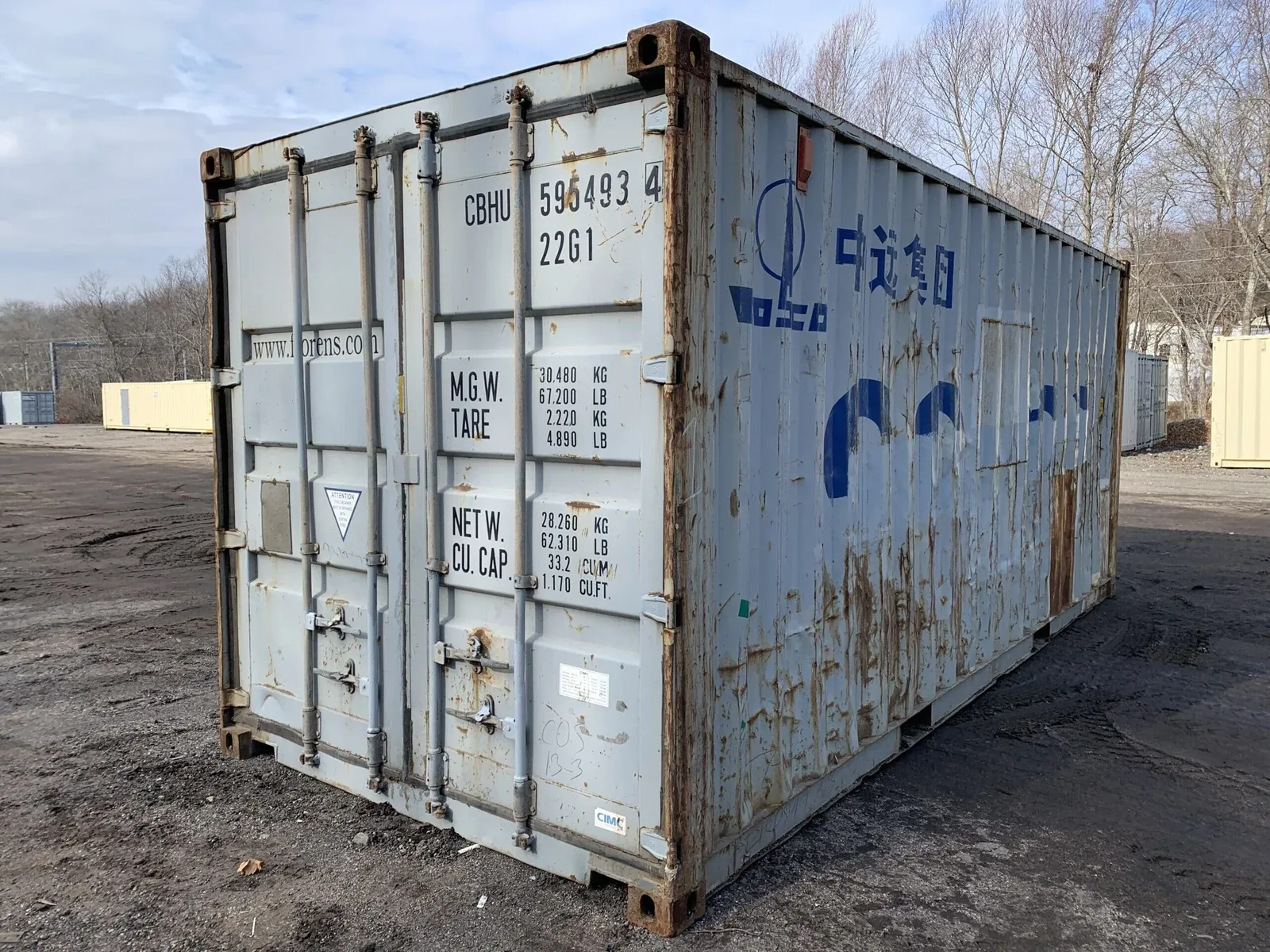
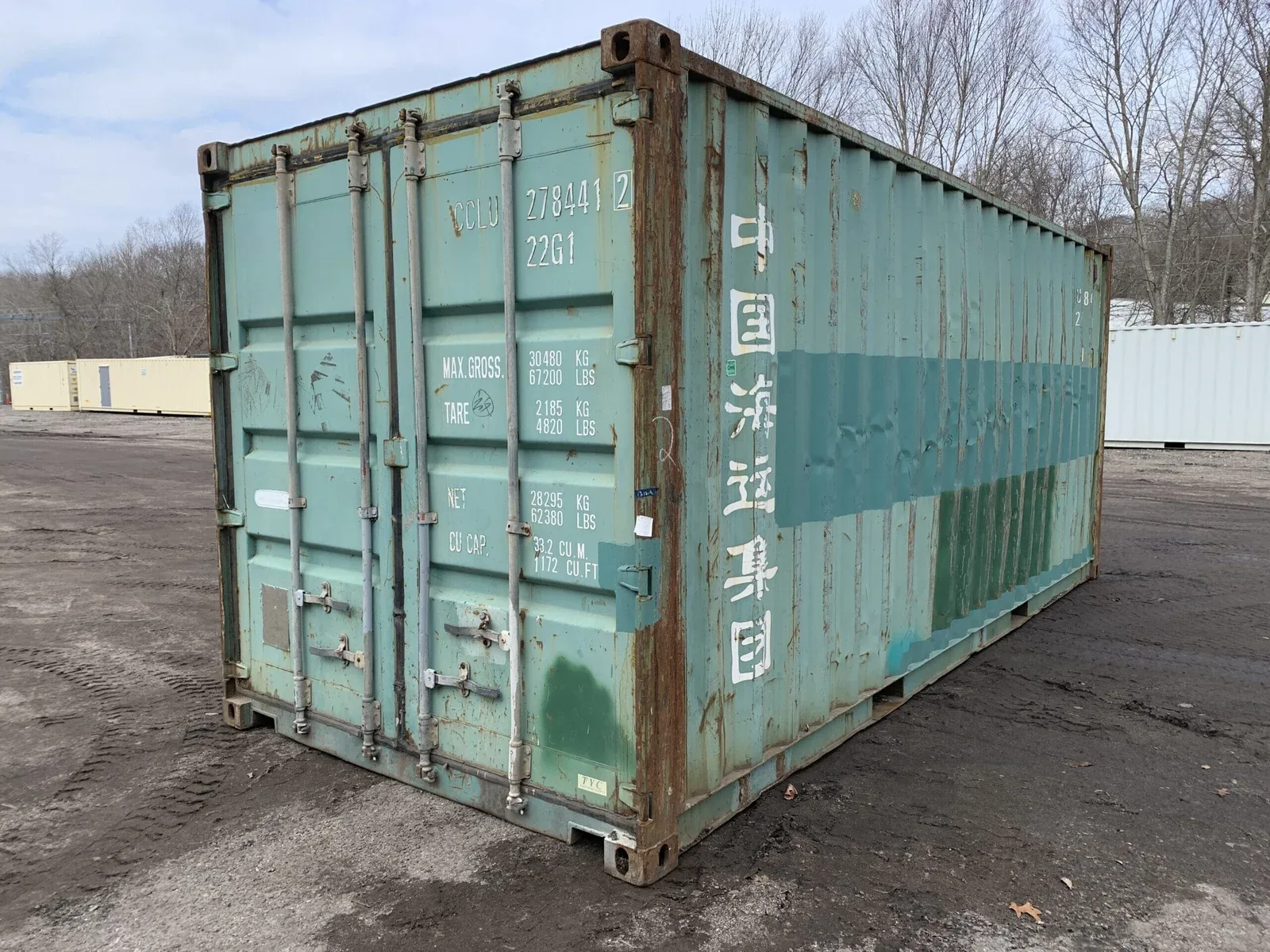
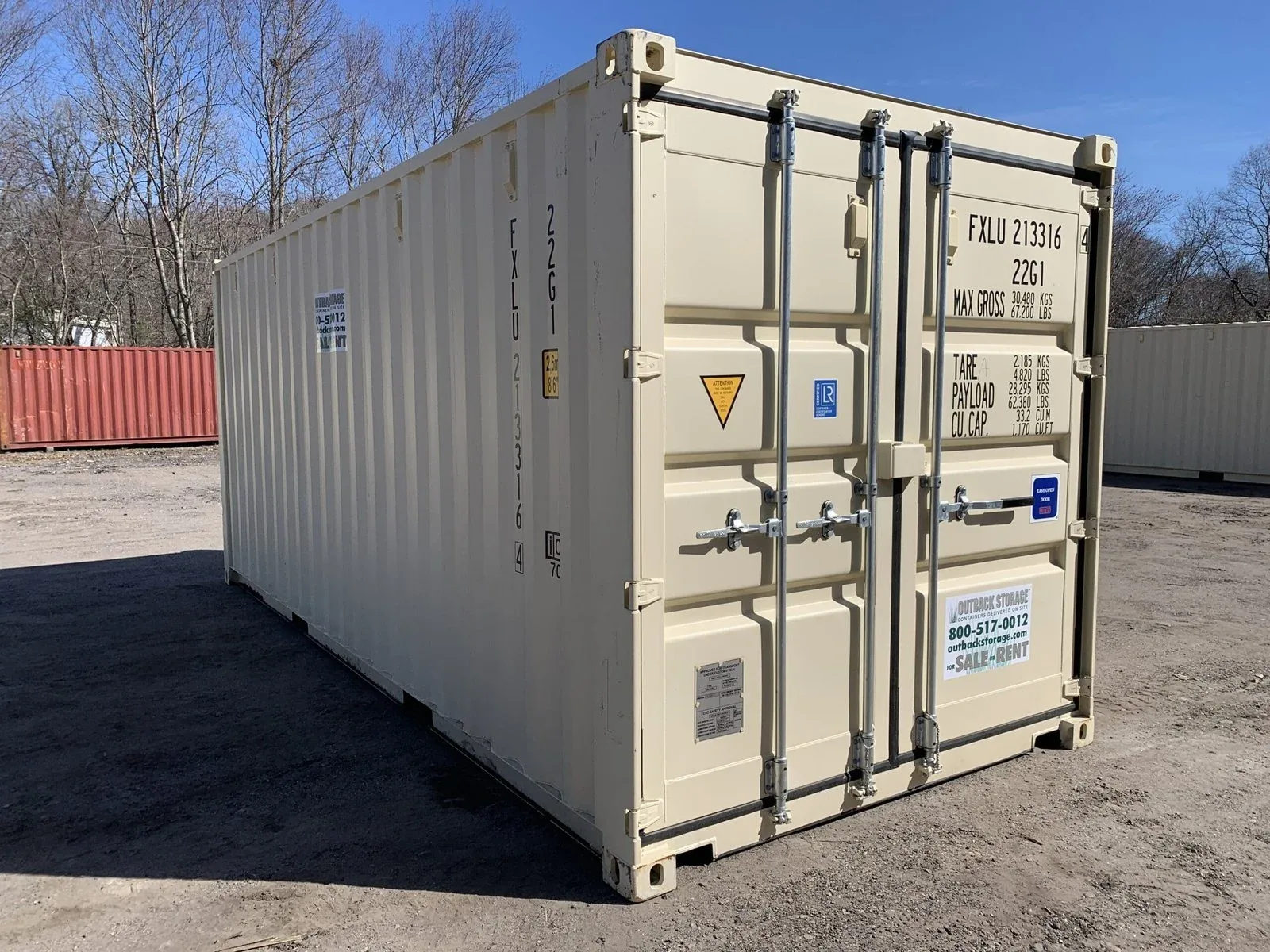
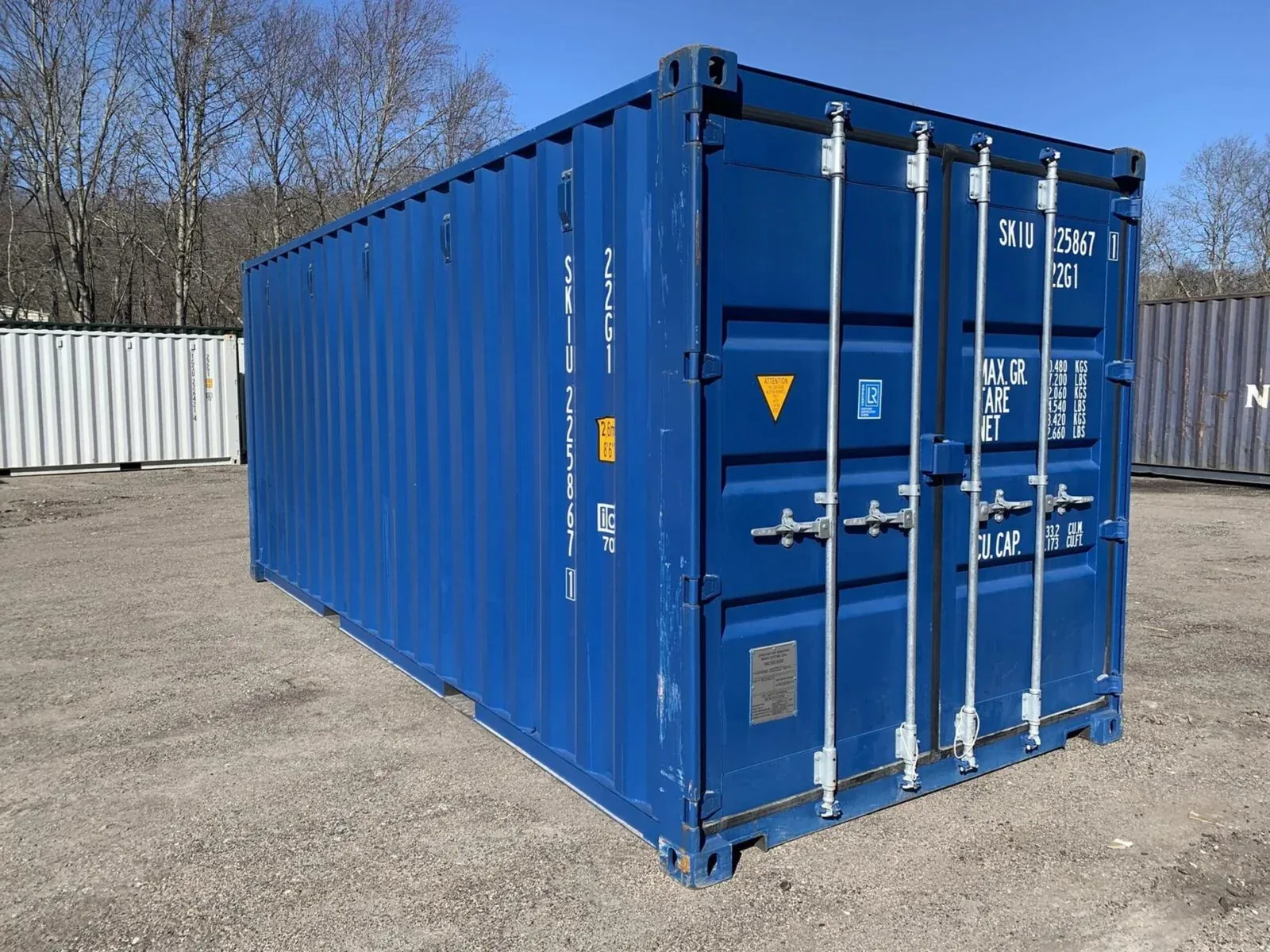
Every listing states the grade, and the grade is what the same 33 m³ costs.
- New and one-trip — never carried a paying load. Clean timber floor, straight panels, lockbox fitted, doors that seal. The pick for anything you care about, and for a box that will be looked at from the street.
- Used, wind and watertight — dents, faded paint and surface rust, floor sound, doors still seal. Storage gear, tools and materials do not need better.
- Used, as-is — cheapest, expect to spend on it. Fine for gravel, firewood and site rubbish.
New, one-trip or used goes through the grades properly. The 20 ft container range lists every unit on the yard with its grade, real photos and a GST-inclusive price, and the used container range shows what is available now.
Where it goes on your block
A 20 ft is the easy one to place: the tilt-tray needs about 12 m of straight, clear run-in — twice the container length — plus room to pull out, and the ground has to be firm and level. Sleepers, a gravel pad or a concrete slab all work; what to put a container on covers the options.
Delivery is free to any address in Australia, metro, regional or remote, and the freight is already in the listed price — nothing is added to the invoice. Collection from the Melbourne yard is free as well. Boxes are dispatched 2–5 business days after payment clears, and the delivery page sets out the transit windows by state.
If 20 ft is more than you need
The 8 ft and 10 ft boxes cover a garden shed, a bike store or a small site lockup, and they place where a 20 ft will not. The container guide compares the sizes, and the FAQ answers the rest.
Tell us what you are storing — the long items, the tall items and roughly how many ute loads — and we will tell you straight whether a 20 ft does it. Get a quote or ring 0480 837 857. We would rather talk you into the right unit than sell you the wrong one.